AI & Agentforce
Salesforce’s buying spree: what happens when CRM starts running the customer relationship?
RocketCX ·
It just takes one casual browse on LinkedIn to about Braze and Salesforce's latest acquisition. The more interesting story is the pattern around it.
On 20 October, Salesforce announced an agreement to acquire Braze for approximately $5.66 billion. The proposed deal would add a substantial platform for responding to customer behaviour across mobile, web and messaging channels.
It is an agreement, rather than a completed acquisition. Closing is expected in Salesforce’s fiscal 2028, subject to approvals. That distinction matters when discussing what customers can actually implement today.
But read Braze alongside Salesforce’s other recent deals and a larger ambition starts to emerge: connecting what a business learns about its customers with what it does next.
The pieces are starting to form a pattern
Several acquisitions address different parts of that problem.
Momentum, acquired in March, brings conversational insights and revenue orchestration. Qualified, acquired in April following an announcement in December 2025, brings AI agents for engaging and converting inbound buyers. These extend the ways customer conversations can inform commercial activity.
Contentful, acquired in September, adds a composable content platform. Fin, formerly Intercom and also acquired in September, adds a customer service agent platform. Cimulate, acquired in March, brings intent-aware product discovery for commerce.
The announced Listen Labs deal adds a different dimension: AI-led customer research and human simulation. The proposed Loops acquisition targets continuous analysis of business performance and explanations for changes in key metrics. Both remain proposed deals in the announcements reviewed for this article.
Then there is m3ter, acquired in July: technology for metering and billing consumption. Less prominent than Braze, perhaps, but potentially important to understanding the economics of the whole direction.
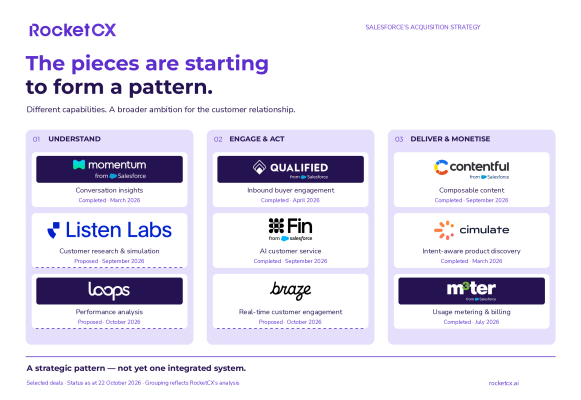
These are different products, with different customers and architectures. They do not yet constitute a single, seamlessly integrated system.
Nevertheless, we've made our best guesses as to the core reasoning behind this spree;
1. Salesforce wants to shorten the distance between understanding and action
A traditional CRM workflow often involves several handovers.
A customer does something. Data is collected. Someone analyses it. Another team decides what to do. A campaign or service process eventually responds.
It's clear that Salesforce wants to compress those handovers.
Research helps explain customer motivations. Conversations reveal changing priorities. Behavioural signals show what someone is doing now. Content and engagement platforms provide ways to respond. Analytics helps assess what happened afterwards.
Braze strengthens the response layer, particularly for high-volume consumer engagement. Listen Labs and Loops suggest an ambition to strengthen the learning around it.
Imagine a subscription business investigating falling retention. Customer interviews suggest a confusing onboarding process. Product behaviour identifies where users get stuck. The business tests revised guidance and measures whether retention improves.
That is an illustrative future workflow, not an announced integration. But it shows why these capabilities might belong in the same strategic picture.
The difficult part will be establishing whether an intervention actually helped. A plausible explanation for a metric change is not proof of causation. Simulated customers are not substitutes for observing real ones.
A system that acts faster also needs a reliable way to learn when it is wrong.
2. The platform may become more important as the interface becomes less visible
There is another possible connection between these deals: users may spend less time moving between applications.
Salesforce explicitly connects Contentful with its Headless 360 strategy. Its Loops announcement describes analytics capabilities that can be triggered through Slack and email.
Our interpretation is that Salesforce is preparing for more work to begin through a conversation, an agent or an automated event, with specialist applications operating behind the scenes.
For customers, that could make the working day simpler.
Underneath, however, the architecture still needs to decide which customer record to trust, which content is approved and which system can take an action.
This creates a potential competitive advantage for Salesforce. If it coordinates the data, permissions and execution behind an interaction, it can remain central even when the user barely sees a conventional CRM screen.
Watch whether integrations provide shared identity, permissions and operational controls. Those details will tell us more than another demonstration of a conversational interface.
3. The less glamorous acquisition may reveal the business model
m3ter deserves attention because autonomous work raises a commercial question: what exactly should customers pay for?
Seats remain relevant for human users. Agents introduce additional possibilities: consumption, completed work and defined outcomes.
Salesforce’s m3ter announcement explicitly links the acquisition to usage and outcome-based pricing capabilities within Agentforce Revenue Management.
That does not prove Salesforce intends to replace every subscription with an outcome charge. It does suggest that measuring and monetising machine activity is becoming a strategic capability.
For buyers, our view is that this changes implementation planning.
A successful pilot needs more than a useful response. It needs an understandable cost per useful result.
That means measuring retries, escalation, repeat contacts and the human work still required. A service interaction that appears resolved but produces another call tomorrow may be cheap automation and expensive service.
Finance and operations need to help define success before an agent goes live.
4. This is also a competitive response
There is a credible, less expansive explanation for the buying spree.
Salesforce is purchasing capable products, specialist teams and established customer relationships in markets where competition is strong.
Reuters framed Braze around AI-driven personalisation. CMSWire examined the implications for Marketing Cloud. Barron’s reported differing analyst views on the price and strategic rationale. The reporting supports several interpretations rather than one inevitable master plan.
Community discussions add useful texture.
In r/salesforce, contributors recognised Braze’s product strengths, including one who described leading a migration from Marketing Cloud to Braze. In r/techsales, others questioned how the purchase fits alongside Salesforce’s investment in Marketing Cloud on core.
Those are individual, unverified accounts, not a representative survey. But they expose the practical question behind the announcement: how will these products fit together?
We should resist both extremes. The acquisition does not establish that Marketing Cloud is being retired. Nor does common ownership establish that integration will be straightforward.
Braze’s leadership has said it will continue building as Braze and remain committed to an open, composable approach. That is the stated direction; delivery will need to be assessed over time.
What this means for implementation
For customers, the opportunity is considerable. So is the scope for buying overlapping capabilities before deciding how they should work.
MarTech’s coverage raises the risk of adding another overlapping layer. TechTarget’s reporting on Loops identifies concrete integration questions, including access to Tableau’s semantic model and single sign-on.
This is where expert services become valuable.
An implementation partner needs to help a business make decisions across the whole workflow:
- Which existing capability should be retained, replaced or connected?
- Where does customer identity live, and how quickly must changes reach other systems?
- Which decisions can an agent make, and which need human approval?
- How are conflicting actions prevented across sales, service and marketing?
- What evidence will demonstrate better outcomes at an acceptable cost?
Consider a customer with an unresolved complaint who is also eligible for a promotional offer.
The engagement platform might correctly identify a conversion opportunity. The service platform might correctly identify a dissatisfied customer. The business still needs a rule for what happens when both are true.
That requires connected data, clear ownership and an agreed customer policy. Installing the products is only part of the work.
The RocketCX perspective
At RocketCX, we see the implementation challenge expanding from configuring individual applications to designing how data, people and automation work together.
The sensible starting point is a specific customer or operational problem. Establish the baseline. Assess the available technology. Connect the necessary data. Define the controls. Pilot the workflow and measure the result.
Sometimes that will justify a new capability. Sometimes it will show that the business can achieve more with what it already owns.
Salesforce’s acquisition strategy may make far more possible across the customer relationship. Whether customers benefit will depend on how those possibilities become dependable, affordable working processes.
That is the gap expert implementation needs to close.
Planning how these capabilities fit your organisation? Discuss your project with RocketCX.